



Rebuild or Refactor?
A Technical Due-Diligence Guide for Founders Sitting on a Fragile MVP
You’ve got the most dangerous thing in startups:
A working MVP.
-
Customers use it.
-
Revenue is trickling in.
-
Screenshots look great in investor decks.
But behind the scenes, you know the truth:
-
Every deploy feels risky.
-
Bugs appear in places that “haven’t been touched.”
-
The original dev/agency is slow… or gone.
-
Your new engineers wince when they open the code.
You’re stuck with the question every non-technical founder eventually faces:
Do we rebuild this thing from scratch, or try to refactor what we’ve got?
Make the wrong call, and you can easily burn 6–12 months of runway
and still end up with something fragile.
This guide is here to help you think like a technical co-founder—
without needing to become one.
Rebuild vs Refactor: Key Considerations
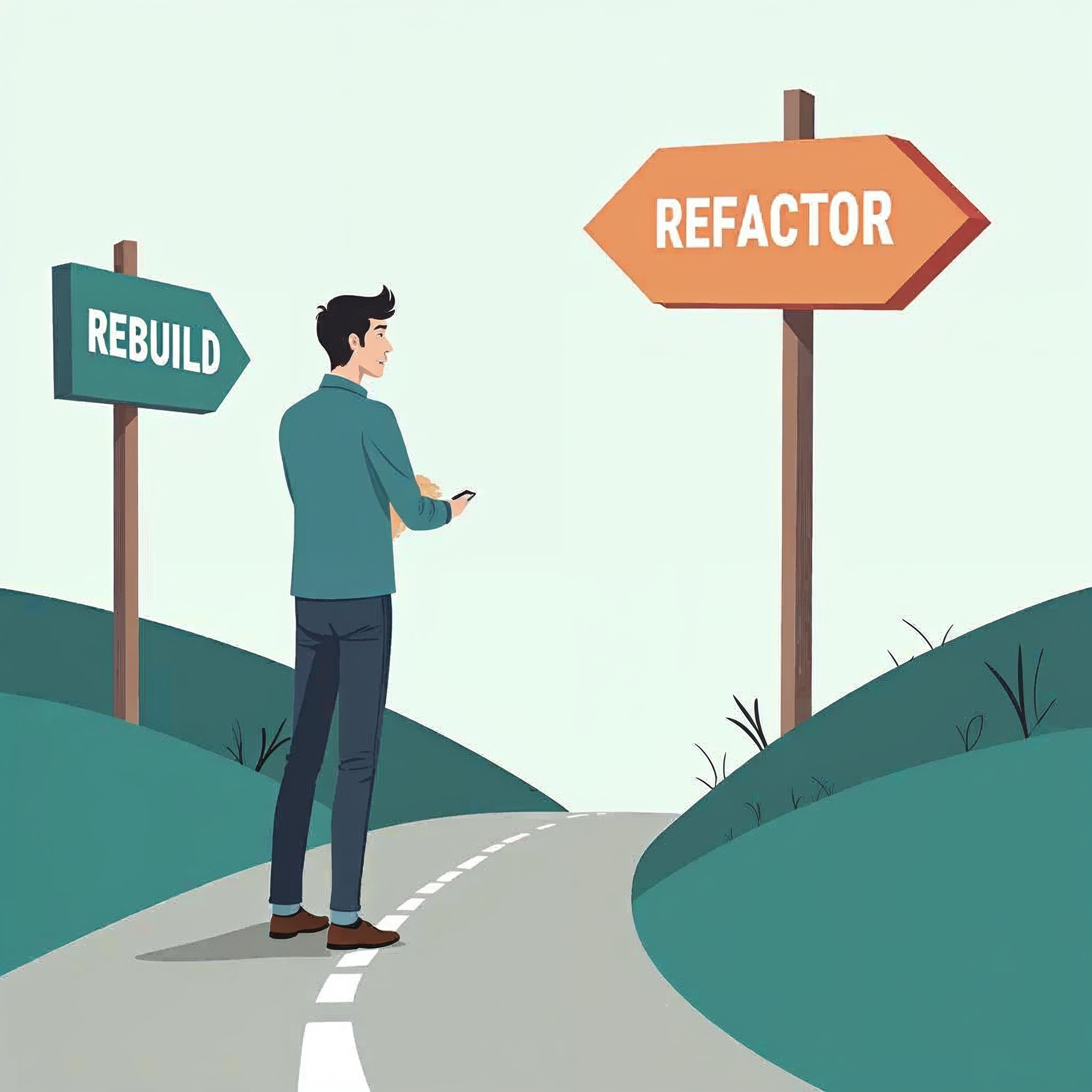
Deciding between rebuilding and refactoring your MVP isn’t easy. This section will help you understand the stability of your current MVP and when major changes are necessary.
1. Why this decision is so hard (and why you shouldn’t avoid it)
“Let’s just keep patching it for now” feels safe.
But in reality, that often means:
-
You keep paying for slow development on top of a shaky foundation.
-
New features take longer and break more things.
-
Your team loses confidence in the product, and customers feel it.
-
When a big opportunity shows up (enterprise deal, big integration, acquisition interest), your tech can’t stand up to even light due diligence.
On the other side, “let’s rebuild” can be equally dangerous:
-
It sounds bold, but can quietly become a never-ending project.
-
The product team is stuck maintaining the old system and waiting on the new one.
-
The business loses momentum while the team “disappears into rebuild mode.”
The reality:
Sometimes you must rebuild. Sometimes refactoring is smarter.
You need a clear, structured way to tell which situation you’re in.
That’s what technical due diligence is for.
2. First, frame the question correctly
Instead of:
“Should we rebuild or refactor?”
Ask:
“What is the fastest, safest path to a codebase that supports
the next 18–24 months of growth?”
This shifts your thinking from:
❌ “Is our current code garbage?”
to
✅ “What’s the most efficient path to a reliable, extensible product?”
From a technical due-diligence lens, that breaks into three core questions:
-
Can this codebase safely support the growth we expect?
-
How expensive is it to keep working with it as-is?
-
What would a target architecture look like—and how far are we from it?
To answer those, we look at specific dimensions.
3. How we (at Technosip) evaluate a fragile MVP
When a founder comes to Technosip with a “we think our code is in trouble” situation,
we don’t start by rewriting anything.
We start with a structured technical audit across these areas:
-
Architecture
-
Is the system logically structured (layers, modules, services)?
-
Are responsibilities separated (API, business logic, UI, background jobs)?
-
Is it designed to scale horizontally if needed?
-
-
Code Quality
-
Is the code readable and consistent, or a patchwork of styles?
-
Are there tests around critical flows (sign-up, login, payments, main actions)?
-
Is there obvious copy-paste logic or “god classes” that do everything?
-
-
Security
-
How is authentication & authorization done?
-
Are there obvious injection risks, exposed admin areas, missing validation?
-
Is sensitive data stored and transmitted safely (encryption, HTTPS, secrets handling)?
-
-
Performance & Reliability
-
How does the app behave under load?
-
Are slow queries, timeouts, or memory issues popping up?
-
Are there logs, metrics, alerts—or is everything a black box?
-
-
Data Model
-
Are the tables/collections reasonably normalized?
-
Are there indexes where you’d expect them?
-
Can we evolve the schema without manual database surgery each time?
-
-
DevOps & Process
-
How do you deploy? CI/CD or manual uploads?
-
Is there a staging environment or only production?
-
How long does it take to go from idea → spec → shipped change?
-
We don’t just answer “good/bad.”
We classify each area like a traffic light:
🟢 Healthy – safe to build on
🟡 Manageable – with targeted refactoring, it’s fine
🔴 Danger zone – likely to cause outages, security issues, or huge dev slowdown
Only after that do we recommend rebuild vs refactor.

Founder and engineers collaborating at whiteboard
4. Checklist: When you must rebuild
If multiple areas are deep 🔴, a rebuild is often cheaper and safer than continuing to patch.
You’re likely in rebuild territory if:
1. The architecture is fundamentally wrong for your future.
-
Everything is in one huge file or giant “god” service.
-
No clear separation between core domains.
-
Any change risks breaking unrelated features.
2. New features are painfully slow and risky to ship.
-
A “small change” takes weeks.
-
Every release introduces new bugs in old areas.
-
Your team is scared to touch certain parts of the code.
3. Performance breaks with modest growth.
-
App slows or crashes with relatively small traffic spikes.
-
No caching, no optimization, inefficient queries everywhere.
-
Fixing one performance bottleneck reveals three more.
4. Security issues are baked into the foundation.
-
Hard-coded secrets in code or repo.
-
No proper auth/permissions model.
-
No way to add audit trails or access logs without major surgery.
5. Tech stack choices block your roadmap.
-
The framework or platform you used (e.g., certain no-code tools)
can’t support the integrations, AI, or workflows your customers are now asking for. -
Key libraries are unmaintained or end-of-life.
6. Your senior engineers say, “Every hour we spend here is wasted.”
-
If trusted technical leaders consistently recommend rebuild,
and they understand the business constraints, listen.
If 3 or more of these are true, especially including architecture/security/stack,
a planned, staged rebuild is usually more rational than infinite refactors.
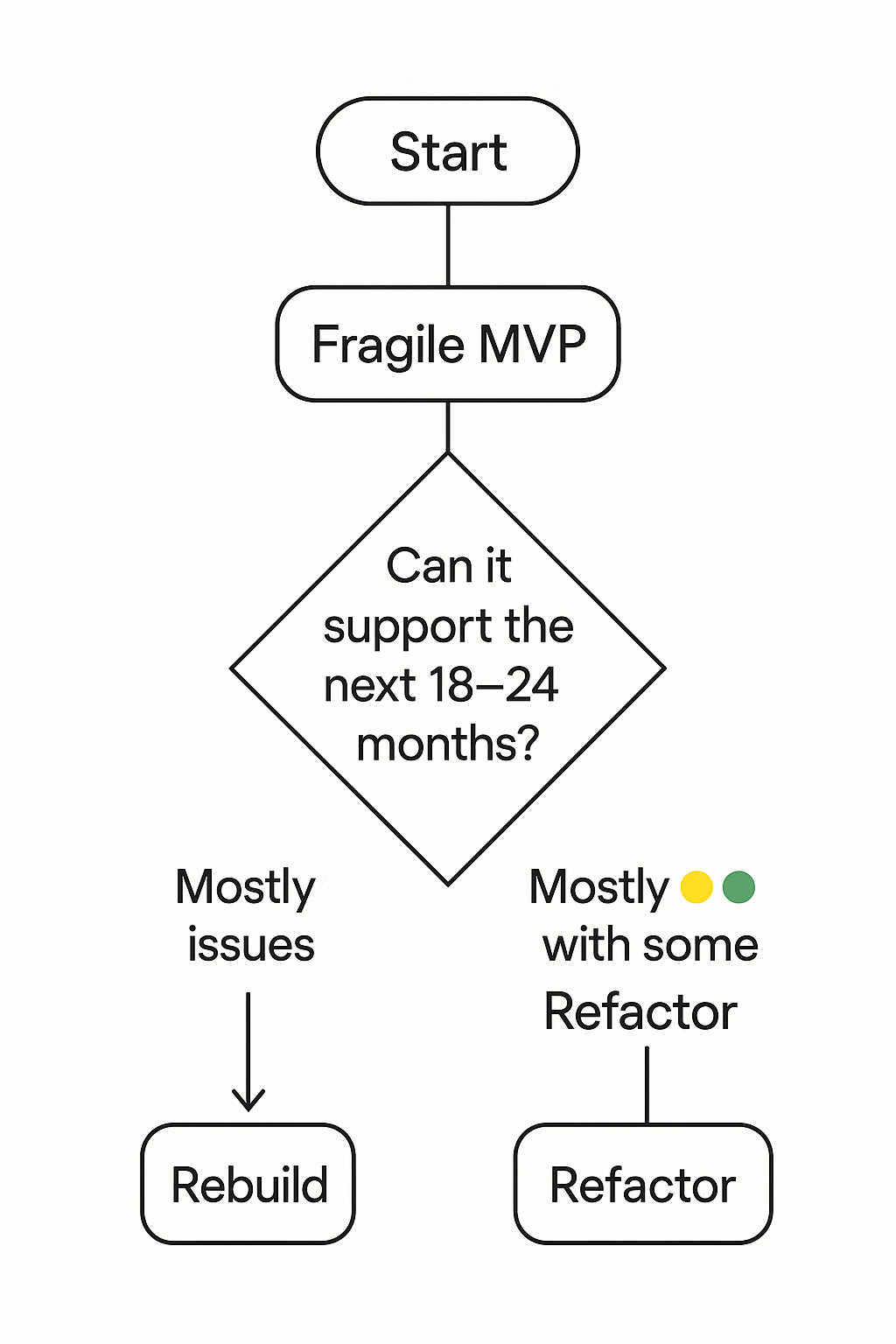
Flowchart showing how to decide between rebuilding or refactoring a software MVP
5. Checklist: When smart refactoring is enough
On the other hand, a lot of scary-looking codebases are salvageable.
Refactor (instead of rebuild) if:
-
1. Architecture is messy, but not hopeless.
-
You can still identify clear “domains” (users, billing, core entities).
-
It’s possible to gradually extract modules/services without breaking everything.
-
-
2. Core business logic is solid.
-
The workflows your customers depend on are implemented correctly, just not beautifully.
-
Most bugs are around edges, not fundamentals.
-
-
3. Tests exist—or can be realistically added.
-
Even if coverage is low, you can add tests around critical flows.
-
Refactoring with tests becomes safer and iterative.
-
-
4. Performance issues are local, not systemic.
-
A few slow endpoints or N+1 queries, but no fundamental scaling blockers.
-
Optimizing queries, adding caching, or tweaking infra gives big wins.
-
-
5. Security gaps are patchable.
-
Input validation, secrets handling, basic auth flows can be fixed without rewriting everything.
-
No need to redesign the entire auth/permissions model from scratch.
-
-
6. Your engineers say, “It’s not pretty, but we can work with this.”
-
They see a path to improve things incrementally.
-
You have enough runway to support a refactor while shipping features.
-
In these cases, a guided refactor can:
-
Preserve your existing investment
-
Avoid a scary “big bang” rewrite
-
Let you keep shipping value while improving the foundation behind the scenes
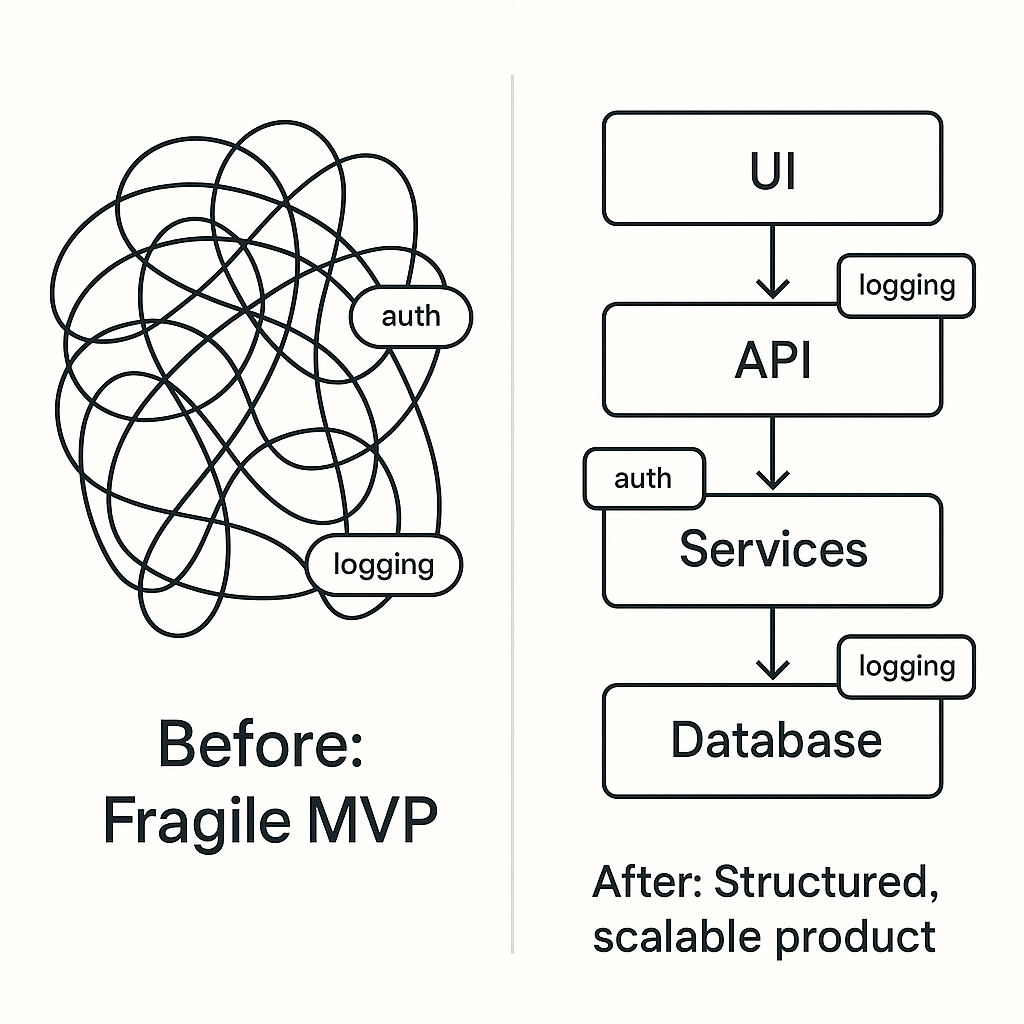
Messy vs. structured architecture comparison
6. How Technosip answers “rebuild vs refactor” for you
As a founder, you shouldn’t have to guess.
Here’s how we handle this at Technosip for startups sitting on a fragile MVP.
Step 1: Product & business context (not just code)
Before touching the repo, we ask:
-
What’s your 12–24 month business goal?
-
What’s your runway and fundraising plan?
-
Who are your best customers, and what workflows are mission-critical?
-
What’s breaking today that scares you most?
This keeps us from recommending a perfect technical solution
that doesn’t fit your time or money reality.
Step 2: Codebase & infrastructure audit
We then do a focused audit across:
-
Architecture
-
Code quality & tests
-
Security & auth
-
Performance & reliability
-
Data model
-
DevOps & deployment
We’re not looking for academic perfection.
We’re asking a practical question:
“Can this support where you want to be in 18–24 months?”
Step 3: The Founders’ Technical Health Report
This is our low-friction entry service—and it’s built specifically for non-technical founders.
You get a clear, non-jargon deliverable that includes:
-
Traffic-light summary
-
A one-page view of each area: Architecture, Security, Performance, Data, DevOps
-
🟢 Good enough
-
🟡 Needs targeted refactor
-
🔴 Structural risk
-
-
Rebuild vs Refactor recommendation
-
A direct, opinionated answer:
-
“Rebuild is the cheaper long-term path” or
-
“Refactor is viable and here’s how.”
-
-
-
Critical risks & quick wins
-
3–5 things we’d fix immediately to reduce outage/security risk.
-
Things that protect you now even before a bigger decision.
-
-
A 3–6 month action plan
-
If refactor: concrete steps to improve reliability and speed of delivery
while still shipping features. -
If rebuild: a staged plan that avoids “stop everything for 9 months and pray.”
-
This report is meant to be founder-friendly enough that you can:
-
Share it with your team
-
Share it with advisors or investors
-
Use it as your internal north star for technical decisions
7. What happens after the report?
You have options.
-
You can take the report to your existing dev team and use it as a roadmap.
-
You can invite Technosip to own the refactor or rebuild with you.
-
You can even use it as part of your fundraising story:
“We’ve done technical due diligence on our MVP.
Here’s our plan to scale safely over the next 12 months.”
When founders choose to partner with us after the report, we typically:
-
Stabilize the current system (patch critical risks, add observability)
-
Start executing the refactor or staged rebuild
-
Keep the business moving: new features, better onboarding, customer-driven improvements
The point is simple:
You should never feel like “engineering is on a different planet” again.
8. The decision in front of you
If you’re reading this, you probably already feel it:
-
Your MVP is valuable but fragile.
-
Some part of you knows “we can’t scale this as-is.”
-
The question is when and how, not if, you’ll pay down the tech debt.
You don’t have to guess.
You don’t have to become technical.
You don’t have to wait for a catastrophic outage to get clarity.
Ready to find out if you should rebuild or refactor?
At Technosip, we created the Founders’ Technical Health Report
so non-technical founders can get a clear, honest answer to:
“Is our current MVP a solid foundation—or a ticking time bomb?”
If you’re sitting on a fragile MVP and unsure what to do next:
-
Reach out and mention “Technical Health Report”
-
We’ll walk you through what the audit looks like for your product
-
And help you decide: rebuild or refactor?
You already did the hard part:
You built something customers care about.
Now let’s make sure the product underneath
is strong enough to carry the company you’re building.